
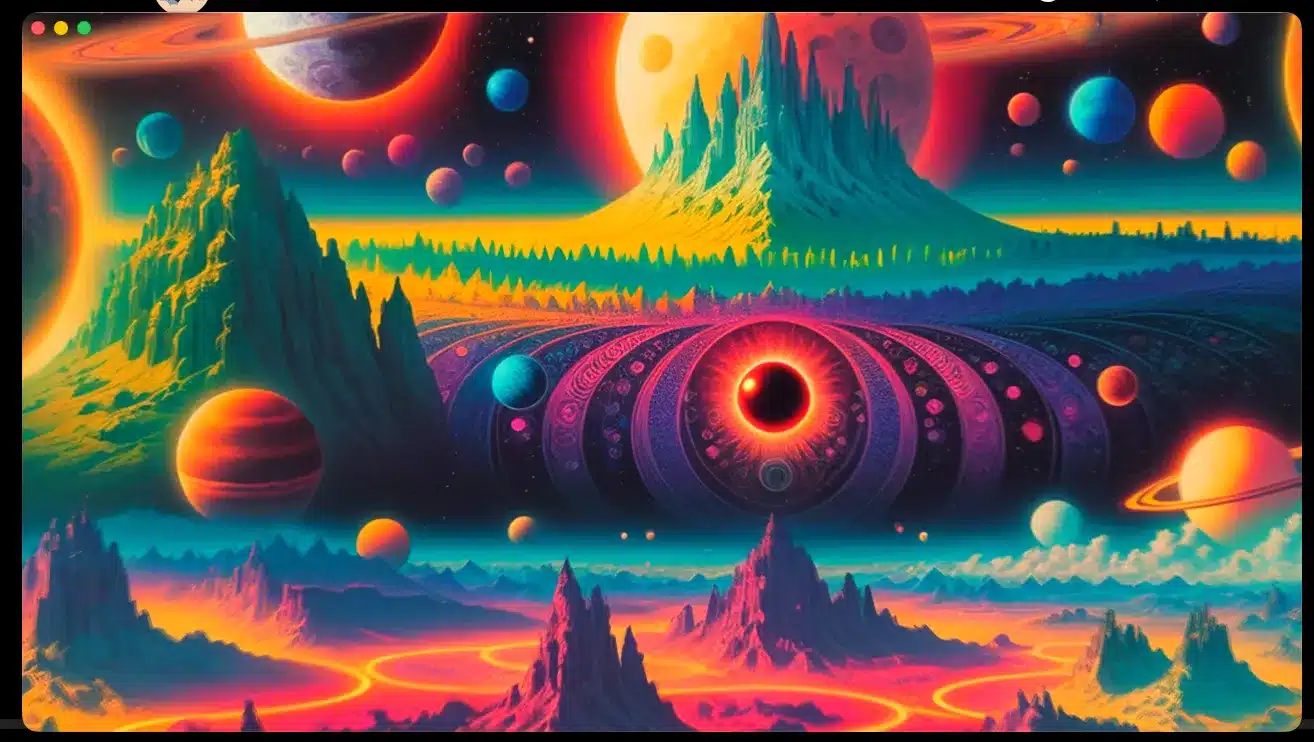
Introducing Infinidream.ai
What If Your Screen Never Really Went Dark? Infinidream.ai turns idle displays into living AI paintings. Free for Mac and Windows TL;DR: Infinidream.ai is a new Mac and Windows app…

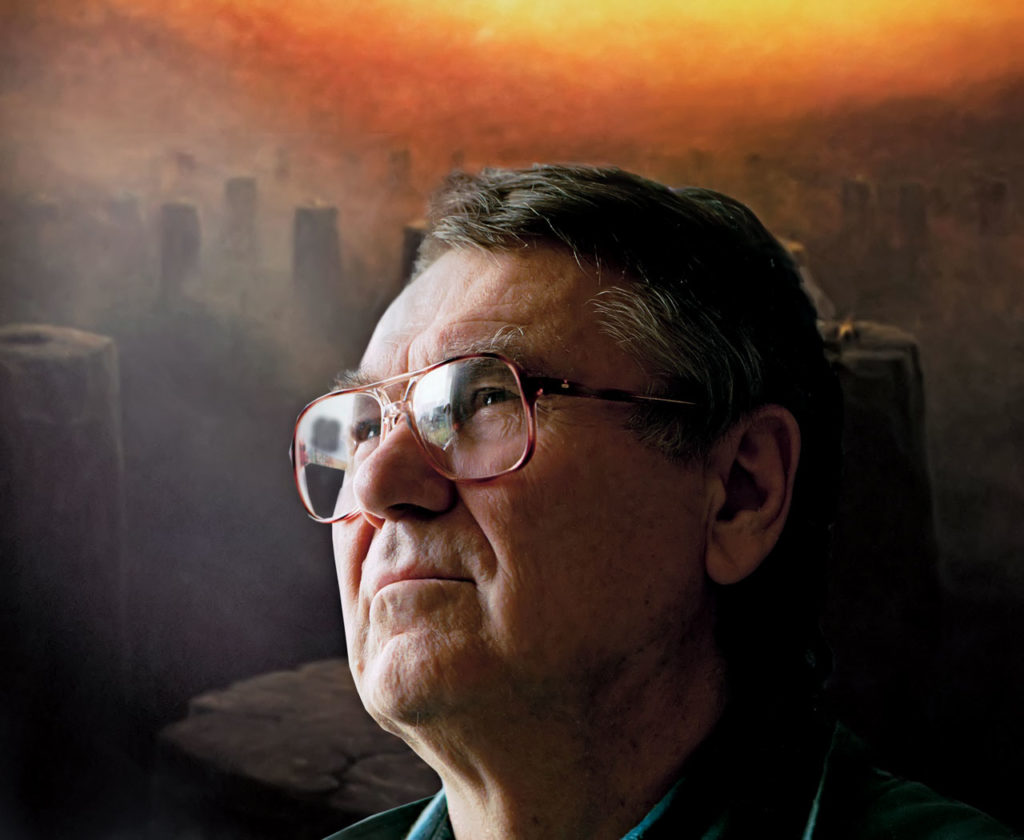
Zdzisław Beksiński
Born: February 24, 1929; Sanok, Poland
Died: February 21, 2005; Warsaw, Poland
Active Years: 1953 – 2005
Nationality: Polish
Art Movement: Surrealism
Zdzisław Beksiński was a Polish painter, photographer, and sculptor specializing in dystopian surrealism. He made his paintings and drawings in what he called either a “Baroque” or a “Gothic” manner. His work spans two major creative periods: an expressionistic, color-rich phase defined by surreal architecture and doomsday imagery, and a more abstract, formal style marked by the aesthetics of decay. He was murdered in his Warsaw apartment in 2005.
– Wikipedia


The first time you encounter a Beksiński painting, something shifts. Not a gasp, not revulsion exactly – more like the feeling of having stumbled into someone else’s recurring nightmare. The figures are wrong. The architecture has no business existing. The light comes from nowhere. And yet it is coherent, even beautiful, in the way that dread can be beautiful.
Zdzisław Beksiński (pronounced approximately ZJEESS-waf bek-SHIN-skee; 1929-2005) was a Polish painter, photographer, and sculptor whose work defines what dystopian surrealism looks like at its most fully realized. He has been called the most important morbid painter of the 20th century – an assessment he would have found both accurate and beside the point. He spent five decades building a visual world that has no direct equivalent in Western art history – apocalyptic without narrative, spiritual without religion, horrifying without ever needing a monster.
This guide covers his life in Sanok and Warsaw, his four distinct creative periods, his technique and working process, how his beksiński paintings compare to H.R. Giger, where his work lives today, and the murder that ended one of the most singular careers in 20th-century art.
Zdzisław Beksiński was born on February 24, 1929, in Sanok, a small city in southern Poland. He studied at the Faculty of Architecture at Kraków Polytechnic, receiving his degree in 1952. In the 1950s and early 1960s, before painting became his primary focus, he also produced sculptures – primarily figurative plaster work – alongside his experimental photography. He never trained formally as a painter.
That fact matters less than it might seem. Architecture demands rigorous spatial thinking, structural logic, and an understanding of how form creates feeling. You can see all three in every canvas he ever produced. His painted spaces – the ruins, the vaults, the endless corridors – are not decorative backdrops. They are load-bearing. They have physics. They follow rules, even when those rules are hellish ones.
Many of the most important visual artists in history were trained as architects first. Bernini, M.C. Escher, Piranesi, Gaudí – all of them brought structural thinking into their art in ways that purely trained painters rarely do. Beksiński belongs in that lineage.
He also survived World War II and continued making art under the Polish communist regime, when provocative imagery was actively discouraged by the Soviet-aligned government. That dual pressure – historical catastrophe on one side, state censorship on the other – shaped a body of work that never needed to reference either directly. The darkness was already inside the work.


Before he ever picked up a paintbrush in earnest, Zdzisław Beksiński spent nearly a decade working as a photographer. Between 1953 and 1960, he produced a body of photographic work that remains among the most significant achievements in Polish 20th-century photography – and one of the most underappreciated chapters of his career.
His approach was experimental and deliberately destructive. He worked with amateur photographs and physically destroyed negatives to create abstract, dreamlike images. The results anticipated artistic movements – body art, photo-performance, conceptual photography – that would not become mainstream art-world concerns for another decade or more.
His photographic works are among the most important achievements of Polish 20th-century photography. These works are a precursor to body-art, conceptualism, and photo-media art as the artist worked on an assumption of transgressing existing canons of artistic photography.
[Source]
The connection between Beksiński’s photographs and his later paintings is not merely biographical. It is visual. The simplified, flattened, oneiric quality of his photomontages – the way they stripped the real world down to a kind of dream residue – became the foundational grammar for his paintings. You can trace a direct line from a destroyed negative circa 1957 to the atmospheric distance of the great Fantastic Period canvases.
He abandoned photography as a primary medium by the early 1960s and turned fully to painting. But the eye he developed behind the camera never left.
The term dystopian surrealism gets attached to Beksiński’s work constantly, but it is worth being precise about what it means when applied to him specifically – because his version of it is distinct from any other artist working in the same rough territory.
Surrealism, in the classical sense, draws on the unconscious. The images arrive from dream logic, from the pressure of repressed material, from the collision of things that cannot coexist in waking life. Dalí’s clocks melt. Ernst’s forests grow eyes. The unconscious is a garden of strange possibility.
Beksiński’s surrealism does not feel like possibility. It feels like aftermath. His dystopian surrealism is what remains when something has already ended – civilization, the body, hope, time itself. There is no monster chasing anyone in a Beksiński painting. The horror has already occurred. The figures that populate his canvases are not victims. They are remnants.
The visual grammar of Beksiński’s Fantastic Period is consistent enough to constitute a language of its own. Hellish, desiccated landscapes. Grim, impossible architecture – vaults that continue past any rational scale, ruins that suggest cathedrals designed for a god no longer present. Figures of death and decay that are neither clearly alive nor clearly dead, occupying an intermediate state that has no name.
The emotional register is apocalyptic, but there is no event, no cause, no villain. His paintings create the sensation of a catastrophe without ever depicting one. This is what makes them so persistently unsettling: there is nothing to point at, nothing to explain the feeling. The feeling simply is.
Among the most recognizable recurring motifs of the Fantastic Period is the dead or skeletal tree – bare branches reaching into colorless skies, stripped of all biological life yet still structurally present, refusing to fall. Where a living tree implies growth and time, Beksiński’s dead trees are pure form: anatomy without function. They signal not death so much as the aftermath of death, the thing that remains when all meaning has been stripped away.
His works also sit, unusually, outside of time. Nothing in a Beksiński canvas can be dated to a decade by context clues. There are no period-specific markers. This ahistoricism is part of why the work has aged without any of the staleness that afflicts so much postwar art.
Several beksiński paintings from this period have become defining images in the genre of dark surrealism. “Untitled (The Stampede)” depicts a mass of skeletal or withered figures moving across a landscape with an urgency that feels both animal and ceremonial. “The Fall” presents a figure in descent through a space that reads simultaneously as sky and interior. Works referred to as the “BA” and “BB” series from the 1970s represent the visual peak of the period – compositions of extraordinary tonal control, where the light seems to come from within the ruin rather than falling upon it.
“The Fantastic Art of Beksinski,” published by Morpheus International in 1998, brought his work to the United States in a major way and introduced an entire generation of artists, musicians, and filmmakers to the Fantastic Period. It remains the definitive print collection.


By the mid-1980s, Beksiński’s work had changed enough that he identified it as a separate mode – what he called his Gothic period. The shift is real and significant, though his work never stopped being recognizably his.
The dreamlike distance of the Fantastic Period compressed. The vast hellish landscapes narrowed. The focus moved inward, toward the figure, toward the head. The tone shifted from apocalyptic to claustrophobic.
The dominant imagery of the Gothic period is the deformed or transformed head: faces that have been stretched, eroded, replaced, or reconstituted by processes that are not quite biological and not quite architectural. Less oneiric than the Fantastic Period work, these paintings have a harder, more formal quality. Beksiński himself described them as having “a specific plastic harmony” – a phrase that captures the strange way they feel both disfigured and composed.
Where the Fantastic Period invites you into an expansive, hallucinatory space, the Gothic Period presses you up against something enclosed. The horror is more intimate. It does not need a horizon.
As digital photography and image manipulation became viable creative tools in the early 1990s, Beksiński began working with computer graphics. This returned him, structurally, to his first medium: photography, now filtered through digital manipulation rather than destroyed negatives.
The digital work is technically cruder than his paintings. He acknowledged this himself. The tools available to him in the 1990s were limited, and the results show it. But the imagery is consistent – the same visions, the same obsessions, expressed through whatever tool was available. That consistency is its own argument. He was not a craftsman attached to oil and hardboard. He was a man attached to a particular set of images who used whatever came to hand.
The digital period is best understood not as a late-career experiment but as evidence of the compulsion that drove the entire body of work.
Beksiński created his beksiński paintings on hardboard panels that he personally prepared. The choice of support matters: hardboard is less yielding than canvas, providing a harder, more stable surface that suits the precision of his detail work while allowing for the atmospheric, painterly passages that give his backgrounds their depth.
His manipulation of chiaroscuro – the relationship between light and dark – is central to the work’s power. Light in a Beksiński painting almost never has a visible source. It emanates from within the composition, illuminating figures and architecture with a specificity that feels both natural and physically impossible. This sourceless light is one of the key technical signatures of his style.
The hierarchy of focal points in his compositions is also distinctive. Where a Hieronymus Bosch painting demands attention from every quadrant simultaneously, a Beksiński canvas has one dominant focal point and then one or two distant, receding secondary points. The eye has a path. The space has depth. The composition breathes.
Beksiński worked to music – not as background, but as an essential part of the process. He described music as fulfilling “the role of wallpaper in the creative process,” which undersells it. In an interview with Waldemar Siemiński, he was more direct:
“I have this need for music to smash and tear me apart. Somehow, after fourteen hours of constant listening, only music allows me to paint without any break, standing up, as if there’s no exhaustion. It works better than coffee!”
– Beksiński, in conversation with Waldemar Siemiński
The range was enormous: classical, rock, jazz. Fourteen-hour sessions standing at the canvas, driven by sound. These paintings were not produced in silence. They were produced in a kind of controlled frenzy, with music as the engine.
Beksiński was famously dismissive of interpretation – both his own and others’. He stated: “I cannot conceive of a sensible statement on painting.” He had no interest in providing keys to his imagery and actively resisted people who sought simple explanations for what his work meant.
This refusal connects him to the broader surrealist tradition, which located the value of art in its capacity to bypass rational explanation and operate directly on the unconscious. But it also reflects something more personal: a genuine belief that the paintings communicated something language could not improve upon. To explain them would be to reduce them.
The two most frequently cited influences on Beksiński are Goya and Bosch, and both connections are real, though neither is simple.
Goya’s late Black Paintings – particularly “Saturn Devouring His Son” – share with Beksiński a willingness to look directly at the most disturbing aspects of mortality and violence without flinching and without aestheticizing. Both artists made dark work not as transgression but as honesty. The Bosch connection is more structural: both painters built hell as architecture, as a space you could inhabit with its own logic and rules. But Beksiński’s version is colder, stripped, silent, and impersonal. The suffering is not punitive. It simply is.
Dalí and Beksiński share a surrealist vocabulary – the oneiric landscape, the figure in an impossible space, the melting or distorting of familiar forms. But Beksiński decisively rejects Dalí’s wit, his showmanship, his self-mythologizing. Where Dalí plays, Beksiński endures.
Max Ernst’s contribution is more technical. Ernst’s frottage and decalcomania established the principle of the painted surface as dreamspace, a place where images emerge from material process rather than pure intention. Beksiński’s prepared hardboard panels carry a related logic: the surface is prepared, then the image is discovered within it.
Beksiński’s architectural training is visible in every painting he made. His spaces are not decorative. They are structurally conceived: vaults that bear weight, ruins that follow the logic of their collapse, interiors that expand and contract according to an internal spatial grammar. Where many surrealist painters treat space as pure symbol, Beksiński treats it as built environment. His paintings feel inhabitable in a way that almost no other surrealist work does. This is the architect’s eye, never fully switched off.
No comparison in the world of dark surrealism comes up more often than Beksiński and H.R. Giger. Both worked in the second half of the 20th century. Both explored death, the body, and horror through a surrealist visual language. Both resisted simple interpretation. And both operated outside the critical mainstream of Western contemporary art for most of their careers.
Giger’s visual language is biomechanical. The body in his work is fused with machinery – bones that become pipes, flesh that becomes circuitry, sexual anatomy mechanized into function. His nightmare is industrial and specifically postwar Swiss: the human body colonized by its own technology, reproduction and death rendered as engineering problems. His work achieved mainstream recognition through the design of the Alien creature in Ridley Scott’s 1979 film.
Beksiński’s visual language is architectural and spiritual. Where Giger’s figures are fused with machines, Beksiński’s figures dissolve into ruins. The body in his work is not colonized by technology; it is subsumed by time, by decay, by an entropy that feels almost geological. His nightmare is Polish and postwar in a different register: not industrial but existential, not mechanical but theological. The soul, in Beksiński’s world, is not destroyed. It persists as ruin.
Their cultural contexts diverge sharply. Giger came from neutral, industrial Switzerland, shaped by postwar prosperity and the anxieties of nuclear-age technology. Beksiński came from a Poland that had been invaded, occupied, and restructured twice within his lifetime, and spent his most productive decades making art under a government that actively discouraged dark or individualist imagery. The darkness in Beksiński has a historical weight that Giger’s – for all its genuine power – does not carry in the same way.
The most accurate frame is not competition but complementarity. Giger shows you what the body fears from outside – from technology, from the alien, from violation. Beksiński shows you what it fears from inside – from time, from the self, from whatever waits after the body is gone. Both created bodies of work that outlasted any particular critical moment, and both deserve far more institutional attention than they have received.
Beksiński’s influence on the aesthetics of contemporary horror, metal music, and dark fantasy illustration is enormous and significantly under-documented. His imagery has become part of the visual DNA of extreme and doom metal album artwork, of horror game art, of the entire tradition of dark fantasy illustration that runs from Frank Frazetta’s successors through contemporary digital artists.
His landscapes in particular – the vast, desolate, architecturally impossible vistas of the Fantastic Period – have shaped how a generation of visual artists imagines the post-apocalyptic. The contemporary genre of “dark core” digital art, which circulates widely online, owes him an enormous debt that is rarely acknowledged directly.
Few endorsements from anyone in popular culture carry more authority on this subject than Guillermo del Toro, the director of “Pan’s Labyrinth” and “The Shape of Water,” whose own visual sensibility is deeply influenced by the tradition Beksiński represents.
“In the medieval tradition, Beksinski seems to believe art to be a forewarning about the fragility of the flesh – whatever pleasures we know are doomed to perish – thus, his paintings manage to evoke at once the process of decay and the ongoing struggle for life.”
– Guillermo del Toro
That description locates Beksiński precisely in the tradition of memento mori painting – art that functions as a reminder of mortality – while acknowledging the particular tension in his work between decay and vitality. His figures are not merely dead. They are in process. Something is still happening to them.
Beksiński’s marginal status in the Western art-historical canon is a function of several factors operating simultaneously. He was Polish, and the Western art world has always had a structural bias toward Parisian and New York-centered movements. He worked in genres – surrealism, dark fantasy, apocalyptic painting – that postwar critical consensus ranked below abstraction and conceptualism. He refused the kind of public intellectual positioning that critics use to build canonical narratives.
None of these are arguments about the quality of his work. The work is extraordinary. Art criticism will eventually arrive at a reckoning with Beksiński – his imagery has already proven more durable than most of what the 20th century canonized.
The single most important destination for anyone serious about Beksiński’s work is the Beksiński Gallery in Sanok, housed within the historic royal castle in the city where he was born. The collection holds approximately 600 works, spanning his entire creative life from early photography through the digital period. No photograph reproduces the scale and surface quality of his paintings adequately. The hardboard panels, the impasto passages, the way the light plays across a prepared surface – none of that survives reproduction. Sanok is the only place to experience the work as it was made.
The gallery is part of the Historical Museum of Sanok (Museum of Podkarpacie), and the castle setting is not incidental. The building itself has the weight and age that Beksiński’s work seems to require.
For those who cannot make the trip to Sanok, the most comprehensive print resource remains “The Fantastic Art of Beksinski,” published by Morpheus International in 1998. The book brought his work to English-language audiences in significant quantity and remains the most thorough reproduction collection available in print.
Digital archives exist across several platforms, though reproduction quality varies considerably. For research purposes, the Museum of Podkarpacie maintains documentation of the Sanok collection.
Beksiński’s life ended abruptly, violently, mid-sentence. On February 21, 2005, he was stabbed to death in his Warsaw apartment. The killer was Robert Kupiec, the teenage son of Beksiński’s caretaker – a young man Beksiński had refused to lend 100 dollars. Kupiec was convicted and sentenced to 25 years in prison.
The circumstances require some context to be properly understood. By 2005, Beksiński had already lost almost everyone. His wife Zofia died in 1998. His son Tomasz – a well-known radio presenter in Poland – died by suicide on Christmas Day 1999. Beksiński had spent the last years of his life alone, working.
On the morning of his murder, he wrote in his journal:
“Maybe, against all odds, I’ll manage to finish the painting today.”
He did finish it. A few hours later, his body was found in his apartment. The completed painting, signed “Y,” was found in his studio.
That final journal entry is impossible to read without feeling the weight of everything he had already survived. He was not thinking about death. He was thinking about the painting. The painting was the point.
The work signed “Y” has become one of the most discussed images in his catalogue – not because it is his greatest work, but because it is the last act of a life spent, in some fundamental way, in service to a vision that no one outside him fully understood. Critics have called his paintings cursed; the events of his life make that word hard to argue against.

There is no single “most famous” Beksiński painting in the way there is a Mona Lisa or a Starry Night – his fame is tied to a body of work rather than a single iconic image. The most widely reproduced beksiński paintings tend to come from the Fantastic Period of the late 1960s through mid-1980s, particularly works referred to as “Untitled (The Stampede)” and the “BA” and “BB” series. The final painting, signed “Y,” has attracted significant attention since his death.
Beksiński refused to provide explanations for his work, stating “I cannot conceive of a sensible statement on painting.” The recurring themes – death, decay, impossible architecture, figures in states between life and death – are best understood as the visual language of a persistent interior world rather than as symbols with fixed meanings. Guillermo del Toro’s description is useful: the work evokes both the process of decay and the ongoing struggle for life simultaneously.
Dystopian art is a genre characterized by nightmarish, worst-case, or post-catastrophic imagery – visions of how things fall apart rather than how they flourish. Beksiński is one of its defining figures, though he would likely have resisted the label as reductive.
As a general term, dystopian surrealism refers to surrealist art that emphasizes apocalyptic, decayed, or nightmarish imagery – the dark end of the surrealist emotional spectrum. In Beksiński’s work specifically, it means something more precise: art that creates the feeling of aftermath rather than event, of a catastrophe already completed, rendered in a visual language that combines architectural structure with dreamlike atmosphere.
Both explored death, the body, and horror through surrealism, but their visual languages are fundamentally different. Giger’s work is biomechanical – the body fused with industrial machinery. Beksiński’s is architectural and spiritual – the body dissolving into ruin and time. Think of them as complementary rather than competing: Giger shows what the body fears from outside; Beksiński shows what it fears from within.
Beksiński had no formal art training. He studied architecture at Kraków Polytechnic, receiving his degree in 1952, and taught himself to paint through decades of practice. His oil paintings were made primarily on hardboard panels that he personally prepared.
He is most accurately described as a dystopian surrealist – a Polish painter, photographer, and sculptor whose work consistently explored themes of death, decay, and impossible architecture. Some critics use “horror painter” as shorthand, and while his work is undeniably horrifying, that label undersells the formal precision and metaphysical weight he brought to it. He worked in what he called a “Baroque” or “Gothic” manner, depending on the period. His work sits at the intersection of surrealism, dark fantasy, and something that has no clean category name.
Yes, in the broadest sense – his work draws on dream logic, unconscious imagery, and the surrealist tradition of depicting the impossible as though it were real. But his surrealism is darker and more architecturally structured than most. He is the quintessential dystopian surrealist: a distinct subcategory that emphasizes aftermath, decay, and existential rather than playful disorientation.
According to film director Guillermo del Toro: “In the medieval tradition, Beksinski seems to believe art to be a forewarning about the fragility of the flesh – whatever pleasures we know are doomed to perish – thus, his paintings manage to evoke at once the process of decay and the ongoing struggle for life.” Beksiński himself rarely addressed the question directly, preferring to let the work speak without commentary.
He began experimenting with visual art through photography in the early 1950s and transitioned to painting by the early 1960s. His most celebrated period – what he called the Fantastic Period – began in the late 1960s and lasted through the mid-1980s.
In the late 1960s, Beksiński entered what he called his “fantastic period,” which lasted up to the mid-1980s. This is his best-known period, during which he created disconcerting images showing gloomy, surrealistic environments with very detailed scenes of death and decay. He continued painting until his death in 2005.
Beksiński used to say that “music fulfills the role of wallpaper in the creative process.” The music he listened to ranged from classical to rock to jazz. In an interview with Waldemar Siemiński, he stated: “I have this need for music to smash and tear me apart. Somehow, after fourteen hours of constant listening, only music allows me to paint without any break, standing up, as if there’s no exhaustion. It works better than coffee!”
His primary medium was oil paint on hardboard panels that he personally prepared. He also worked extensively in photography in the 1950s, experimented with acrylic, and used computer graphics for digital work from the early 1990s onward.
The largest collection is at the Beksiński Gallery in Sanok, located in the royal castle, which holds approximately 600 works spanning his entire career. The collection within this historical museum spans Beksiński’s entire life. Additional works are held in private collections and other institutions. The Sanok collection is the essential destination for anyone who wants to experience the full scope of his beksiński paintings in person.
Some of Beksiński’s most discussed beksiński paintings include “Untitled (The Stampede),” “The Fall,” and various works from the “BA” and “BB” series produced in the 1970s. He rarely titled his works, so most are identified by catalogue codes or descriptive nicknames assigned by collectors and critics. The final painting, signed “Y,” completed on the day of his murder in 2005, has become one of his most widely referenced works.
Beksiński was murdered on February 21, 2005, by Robert Kupiec, the teenage son of his caretaker. The motive was a loan refusal – Beksiński had declined to lend Kupiec 100 dollars. Kupiec was proven guilty and was sentenced to 25 years in prison.
On the day of his murder, February 21, 2005, Beksiński wrote in his journal: “Maybe, against all odds, I’ll manage to finish the painting today.” He did finish it. The completed work, signed “Y,” was found in his studio after his death and has become one of the most discussed works in his catalogue – the final sentence of an extraordinary life spent in service to a singular vision.
His wife Zofia died in 1998. His son Tomasz, a prominent Polish radio presenter, died by suicide on Christmas Day 1999. Beksiński himself was murdered in February 2005 by Robert Kupiec, the teenage son of his caretaker. He spent the final years of his life alone in Warsaw, continuing to paint.
Several factors converged: he was Polish and largely invisible to the Western market and media networks that build art-world reputation; he worked in surrealism and dark fantasy at a time when critical consensus privileged abstraction and conceptualism; he refused the public intellectual positioning that critics use to write canonical narratives; and he spent most of his career behind the Iron Curtain. His reputation has grown substantially since his death and will likely continue to grow as digital archives make his work more accessible globally.
The two most reliable sources for authorized prints are the Beksiński Gallery shop at the Museum of Podkarpacie in Sanok and shopbeksinski.com, a dedicated print retailer focused exclusively on his work. Exercise caution with Etsy and Amazon listings – unauthorized reproductions are widespread, and print quality on unofficial copies varies considerably. If you are spending meaningful money on a print, buy from one of those two sources or from a verified licensed publisher.
No. He actively resisted interpretation and was dismissive of both those who sought simple explanations and those who offered them. “I cannot conceive of a sensible statement on painting” is his most direct statement on the subject. He believed the paintings communicated something that language could not improve upon or substitute for.
The Beksiński Gallery in Sanok holds approximately 600 works, but this represents only a portion of his total output. He was an extraordinarily prolific artist across five decades, working in oil, photography, and digital media. Many works were sold, given away, or are held in private collections.
The name is pronounced approximately ZJEESS-waf bek-SHIN-skee. The Polish letter “Ł” makes a sound like the English “W,” and the “Ź” that opens Zdzisław is a soft “ZH” sound — nothing like it looks on paper to an English speaker. A rough syllable-by-syllable guide: “zuh-JEE-swaf bek-SHIN-skee.” His surname is the easier half; the given name is where most non-Polish speakers stumble.
Yes. Ostatnia Rodzina (The Last Family), directed by Jan P. Matuszyński, was released in 2016 to wide critical acclaim. The film is a biographical drama covering the Beksiński family from the 1970s through Zdzisław’s murder in 2005. Tomasz Beksiński — Zdzisław’s son, a prominent music journalist and radio presenter who died by suicide in 1999 — is as central to the film as his father. It is widely considered one of the best Polish films of the decade and is the most accessible entry point into the human story behind the paintings.
Yes, though sculpture is the least-discussed aspect of his output. In the 1950s and early 1960s, Beksiński produced plaster sculptures — primarily figurative and self-referential work, often distorted or abstracted. The sculptural experiments informed his painting: the same interest in the human form under pressure, the same willingness to subject the body to strange processes, appears in both. He largely moved away from sculpture once painting became his dominant focus, but the description of him as “painter, photographer, and sculptor” is accurate.


![Secret Dreams Loop Video Pack [Vol 11] – Stock Video Animation pack for use in music videos, VJ Loops and more](https://surrealismtoday.com/wp-content/uploads/2025/05/Secret-Dreams-VJ-Loops-20-scaled.webp)


![Surreal AI Video Pack [Vol 7] – Stock Video Animation pack for use in music videos, VJ Loops and more](https://media.surrealismtoday.com/wp-content/uploads/2023/10/20150552/Surreal-AI-Video-Pack-Vol-7-305x.webp)
![Surreal AI Video Pack [Vol 9] – Stock Video Animation pack for use in music videos, VJ Loops and more](https://media.surrealismtoday.com/wp-content/uploads/2023/11/17125432/best-vj-loops-1005x.webp)
![Surreal AI Video Pack [Vol 8] – Stock Video Animation pack for use in music videos, VJ Loops and more](https://media.surrealismtoday.com/wp-content/uploads/2023/10/24125149/VJ-PACK-8-scaled.jpg)
![Christmas VJ Loop Video Pack [Vol 10] – Stock Video Animation pack for use in music videos, VJ Loops and more](https://media.surrealismtoday.com/wp-content/uploads/2023/11/18113256/christmas-vj-loops-1005x.webp)
![Surreal AI Video Pack [Vol 6] – Stock Video Animation pack for use in music videos, VJ Loops and more](https://media.surrealismtoday.com/wp-content/uploads/2023/10/19213357/Surreal-AI-Video-Pack-Vol-6-105x.webp)
![Surreal AI Video Pack [Vol 5] – Stock Video Animation pack for use in music videos, VJ Loops and more](https://media.surrealismtoday.com/wp-content/uploads/2023/10/08085603/Surreal-AI-Video-Pack-Vol-50105x.webp)
![Surreal AI Video Pack [Vol 4] – Stock Video Animation pack for use in music videos, VJ Loops and more](https://media.surrealismtoday.com/wp-content/uploads/2023/10/08063054/Surreal-AI-Video-Pack-Vol-4805x.webp)
![Surreal AI Video Pack [Vol 3] – Stock Video Animation pack for use in music videos, VJ Loops and more](https://media.surrealismtoday.com/wp-content/uploads/2023/09/27113158/Surreal-AI-Video-Pack-Vol-3305x.webp)