
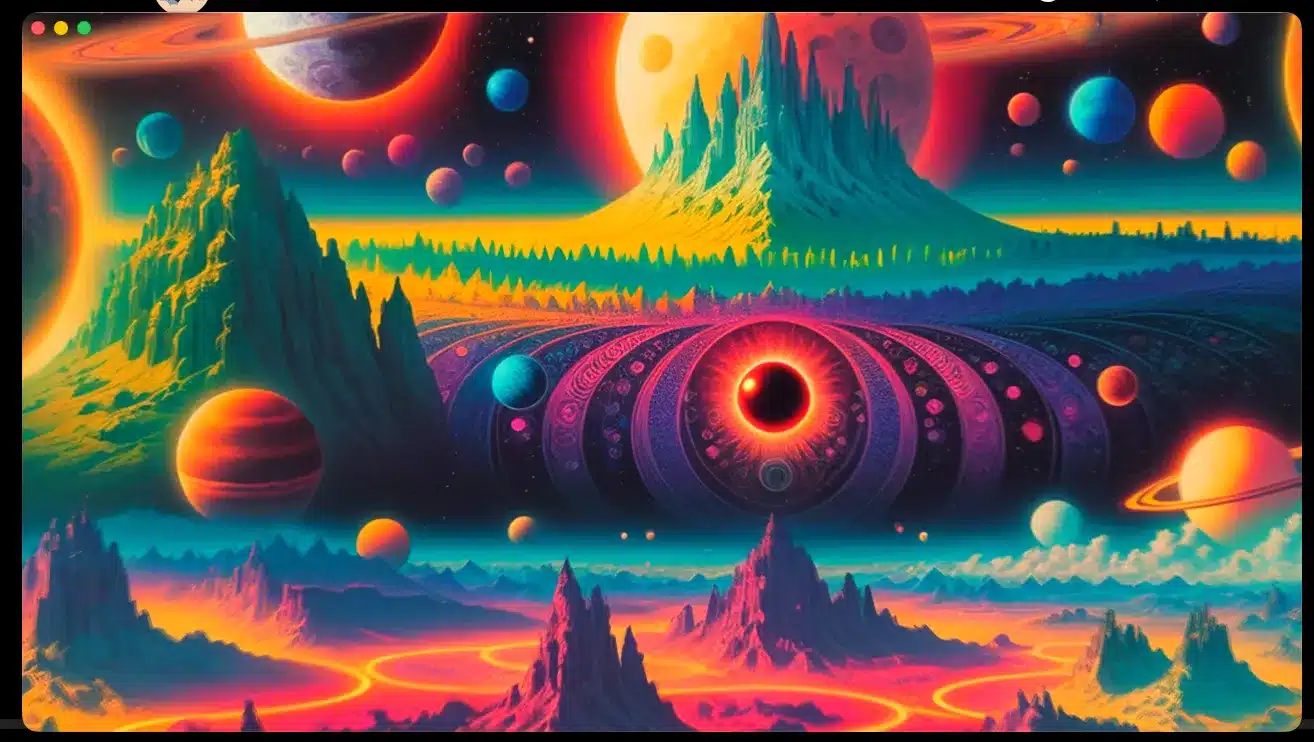
Introducing Infinidream.ai
What If Your Screen Never Really Went Dark? Infinidream.ai turns idle displays into living AI paintings. Free for Mac and Windows TL;DR: Infinidream.ai is a new Mac and Windows app…
Why a SoHo puppet studio belongs on a site about surreal art in every form it takes.
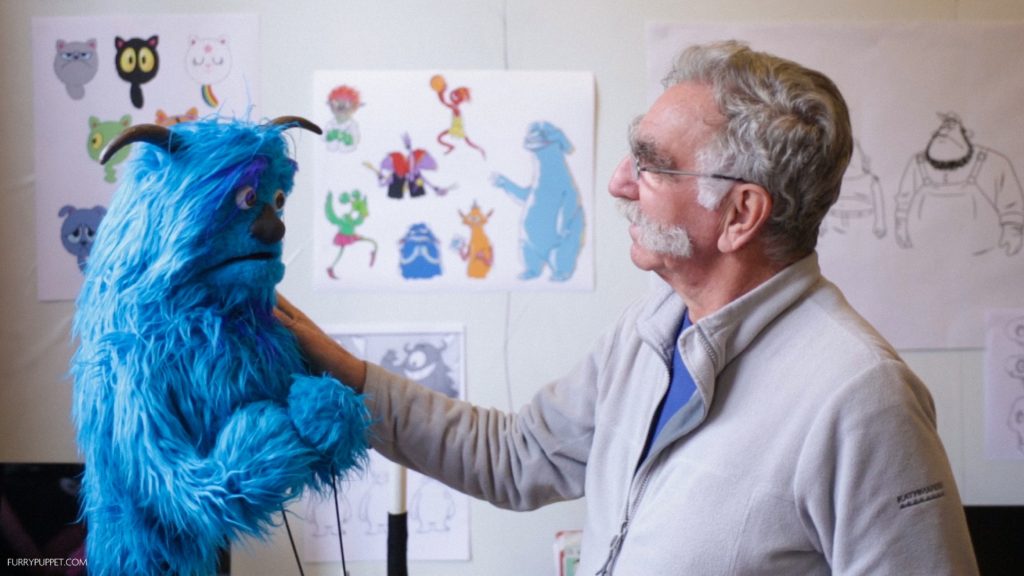
Furry Puppet Studio is a design house in SoHo that builds custom puppets and creatures by hand. “We do pretty unusual work,” is how they describe themselves. Our first instinct, looking through their work, was yes, obviously. Our second was to ask a better question: why does a puppet studio feel so obviously at home here, next to everything else we chase down in the name of the surreal and the psychedelic?
The answer is that puppetry and surreal art have always been after the same impossible thing. Both want to place a being in front of you that has no right to exist, and then convince you, for a few seconds, that it is alive and looking back. Surrealism has never cared what it is made of. Oil paint, celluloid, foam, latex, silicon, a darkened room and a strobe. The material changes with the century. The trick underneath does not.
Look at what this studio actually makes and the word that keeps surfacing is not “cute.” It is “impossible.”
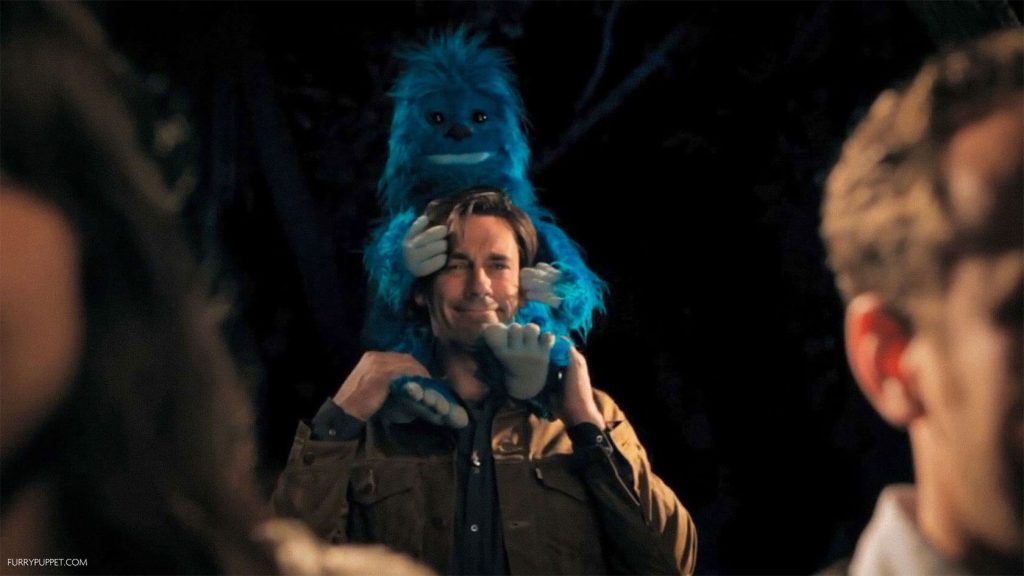
A lovelorn blue yeti walks out of the forest at night and sticks his thumb out for a ride. The car that stops is driven by Jon Hamm. The yeti barely moves for the entire scene, and that stillness is what sells him. That is a Furry Puppet build, made for a Herman Düne music video, and it is a surrealist image by any definition Breton would have recognized: the marvelous inserted into an ordinary roadside and treated as unremarkable by everyone in the frame.
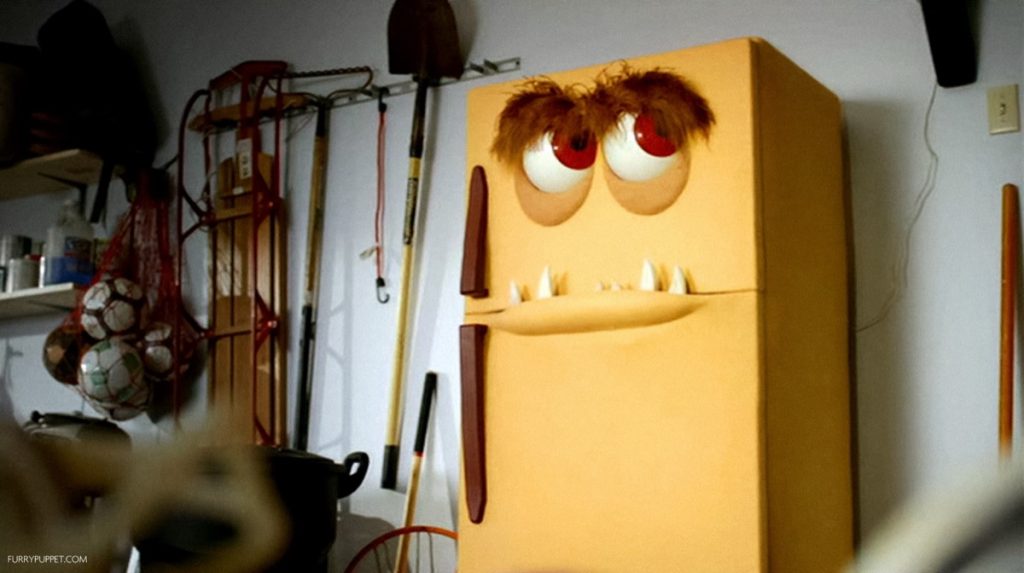
A refrigerator sits humming in a garage with heavy eyelids, bushy brows, and a full set of teeth around the door seam. Animating the everyday object is the oldest move in the surrealist playbook, the one Magritte and Meret Oppenheim built careers on, and Furry Puppet does it as a recurring feature of their work. The appliance is not a joke about appliances. It is the ordinary world caught in the act of being alive.
Anderson Cooper sits on a couch taking a selfie with a foam version of himself. The studio built puppet doubles of Cooper and Andy Cohen for CNN’s New Year’s Eve broadcast, and the resulting photograph is a straight-up doppelgänger image, the exact motif Freud reached for when he tried to define the uncanny. For an Apple campaign in Japan, they went further: characters designed and carved in New York, shipped to Tokyo, then seated on a public bench beside the humans they were modeled on. Two years of work to stage a scene where the copy and the original share a seat in daylight.

Then there is the rest of the register. Missy Elliott and Pharrell rebuilt as full marionettes for “WTF (Where They From),” with the puppets’ insides reengineered so street dancers could drive them. Matt Damon zipped inside a shaggy green mascot suit on Jimmy Kimmel, playing the face of a phone-free schools campaign that promptly became a screen celebrity. A pair of deadpan vultures dispensing safety advice from the Utah backcountry. A family of mechanized monsters with a single oversized eye apiece. Grumpy Cat, sitting on a studio windowsill among blue monsters, 3D-printed eyeballs, and neon birds.

None of this is theoretical surrealism. It is surrealism you can walk up to.
The method is worth knowing because it explains the results. Furry Puppet was founded by Zack Buchman, who never went to college and credits that with giving him an outsider’s angle on the entire craft. Everything happens in-house in SoHo. Every creature starts as a block of foam somebody carves by hand, with no undo, then gets wrapped in a fabric the studio manufactures itself and calls “dream fleece.” The team includes a foam carver Buchman describes as a real-life Edward Scissorhands, a mechanical engineer, and Polly Smith, a legendary costume designer and co-inventor of the sports bra.
The eyes go on last. Buchman talks about that moment as the hinge, where a fractional shift can turn a creature from gentle to menacing, from suspicious to approachable. Everything before it is fabrication. That single adjustment is where the thing starts looking back at you.

He describes the goal as the instant disbelief clicks off, when your brain stops hunting for the rods and simply accepts that what it is seeing is alive. That is not a puppeteering note. That is the entire project of surrealism, stated plainly by someone who happens to work in foam.
If Furry Puppet is the craftsman’s version, Big Nazo is the version that kicks the door in. Founded in Providence in 1986 by Erminio Pinque, a RISD-trained illustrator originally out of New York, Big Nazo set out to be, in Pinque’s own framing, a puppet show without the stage. The name is Italian for “big nose.” The output is a steady flow of foam-fabricated, wearable alien creatures that roam street parades, festivals, and what the troupe cheerfully calls creature dance parties.
This is surrealism as public ambush. André Breton wanted the marvelous to erupt into ordinary life, and there is no purer demonstration of that idea than a nine-foot foam insect turning a normal street corner into a dream nobody agreed to have. Pinque goes a step further and builds his whole practice around chance. He has said the accidents, the things that go wrong on tour, are where the good juxtapositions come from, and that traveling far from what he knew left him “free to fail wonderfully.” Swap “creature costume” for “canvas” and that is automatism, the surrealist faith that the accident knows something the plan does not.
Big Nazo is proof that the uncanny does not need a screen. It just needs foam and nerve.
Most people file Jim Henson under childhood and leave him there. But before “Sesame Street,” and in the gaps between his Muppet work, Henson was a genuinely experimental filmmaker, and it is worth pulling that history back into the light.
His 1965 short “Time Piece” runs about nine minutes, has no dialogue and no puppets at all, and was nominated for an Academy Award. The Museum of Modern Art screened it. It moves on pure associative logic: a man in a hospital bed, a heartbeat that turns percussive, a cowboy shooting a hole through the Mona Lisa, a gorilla on a pogo stick, clocks everywhere creeping toward midnight. It is a surrealist film in the fullest sense, made by the man the culture remembers as a children’s entertainer.
He kept going. He produced “Youth ’68,” a countercultural documentary about drugs and the era for NBC’s experimental television series. He performed a minimalist piece built from a string face against the music of Raymond Scott. And when he finally made “The Dark Crystal” in 1982, he wanted it darker and stranger than the studio was comfortable with, and reportedly bought the film himself rather than sand the weirdness off. Henson is the reminder that the puppet is an avant-garde instrument that simply got very, very good at charming kids. The strangeness was there first.
So where does this leave us, a place built for surreal and psychedelic art wherever it happens to live? On common ground with the puppet makers, it turns out, over two things worth naming.
The first is the uncanny valley. Masahiro Mori described it in 1970, and puppet makers have been working its edge ever since, tuning a face until it reads as alive rather than as broken. It is the same territory a painter walks when a portrait’s eyes start to follow you, the same edge a filmmaker rides, the same one anyone generating creatures from code now lives on. The craft never changes with the tool: make the not-quite-real feel intentional.
The second is belief, and its secret ingredient is weight. A carved monster, a painted one, a projected one, and a rendered one are all chasing an identical target, a viewer who forgets they are looking at a manufactured object. Puppetry gets there through mass, warmth, and physical presence, and that is exactly why it is worth studying no matter what medium you work in. The puppet makers have three quarters of a century of hard-won knowledge about the precise moment a made thing starts to breathe. Anyone conjuring creatures, out of foam or film or a prompt, should be reading over their shoulder.
Which is a long way of saying yes to Big Nazo, and yes to the Henson archive, and yes, most immediately, to the studio that started this whole train of thought.
It is worth picturing what sits behind these images. Somewhere on Broadway in SoHo, right now, there is a room with foam shavings on the floor, a wall of hand-sculpted eyes waiting to be assigned to faces, and a bolt of dream fleece that exists nowhere else because the studio manufactures it themselves. Every creature in that room was carved by a person making permanent cuts into a block with no undo. Buchman has talked about the confidence that demands, and it is the same nerve Pinque describes when he says the accidents are where the good work comes from, and the same one Henson had when he pointed a camera at a cowboy shooting the Mona Lisa and trusted an audience to follow him.

![Ventriloquist dummy wearing a red cap and green jacket stands at a desk with a wooden cutting board on it in a bright room.”],](https://i0.wp.com/surrealismtoday.com/wp-content/uploads/2026/07/Likeness-custom-puppet-of-Desus-Nice-1024x1024.jpg?ssl=1)


That through line is the reason this belongs here. A studio does not need to share your medium to share your project. And Furry Puppet is not a puppet vendor that happens to make odd things. They are surrealists with a fabrication shop, working in the tradition of the animated object and the uncanny double, who have quietly gotten some of the strangest images of the last decade onto national television by way of a client invoice.
If you want the experience rather than the argument, it is already scrolling past you. The yeti on the roadside, the refrigerator with eyelids, Anderson Cooper meeting his foam twin: every image in this piece comes straight from the studio’s own archive. Sit with the fact that all of them exist as physical objects in a room in SoHo, and that somebody carved each one out of a solid block with a blade.
The full custom puppet catalog, and there is a lot more of it, lives at furrypuppet.com.


![Secret Dreams Loop Video Pack [Vol 11] – Stock Video Animation pack for use in music videos, VJ Loops and more](https://surrealismtoday.com/wp-content/uploads/2025/05/Secret-Dreams-VJ-Loops-20-scaled.webp)


![Surreal AI Video Pack [Vol 7] – Stock Video Animation pack for use in music videos, VJ Loops and more](https://media.surrealismtoday.com/wp-content/uploads/2023/10/20150552/Surreal-AI-Video-Pack-Vol-7-305x.webp)
![Surreal AI Video Pack [Vol 9] – Stock Video Animation pack for use in music videos, VJ Loops and more](https://media.surrealismtoday.com/wp-content/uploads/2023/11/17125432/best-vj-loops-1005x.webp)
![Surreal AI Video Pack [Vol 8] – Stock Video Animation pack for use in music videos, VJ Loops and more](https://media.surrealismtoday.com/wp-content/uploads/2023/10/24125149/VJ-PACK-8-scaled.jpg)
![Christmas VJ Loop Video Pack [Vol 10] – Stock Video Animation pack for use in music videos, VJ Loops and more](https://media.surrealismtoday.com/wp-content/uploads/2023/11/18113256/christmas-vj-loops-1005x.webp)
![Surreal AI Video Pack [Vol 6] – Stock Video Animation pack for use in music videos, VJ Loops and more](https://media.surrealismtoday.com/wp-content/uploads/2023/10/19213357/Surreal-AI-Video-Pack-Vol-6-105x.webp)
![Surreal AI Video Pack [Vol 5] – Stock Video Animation pack for use in music videos, VJ Loops and more](https://media.surrealismtoday.com/wp-content/uploads/2023/10/08085603/Surreal-AI-Video-Pack-Vol-50105x.webp)
![Surreal AI Video Pack [Vol 4] – Stock Video Animation pack for use in music videos, VJ Loops and more](https://media.surrealismtoday.com/wp-content/uploads/2023/10/08063054/Surreal-AI-Video-Pack-Vol-4805x.webp)
![Surreal AI Video Pack [Vol 3] – Stock Video Animation pack for use in music videos, VJ Loops and more](https://media.surrealismtoday.com/wp-content/uploads/2023/09/27113158/Surreal-AI-Video-Pack-Vol-3305x.webp)