This website uses affiliate links which may earn a commission at no additional cost to you.
Who is Jesús Aguado
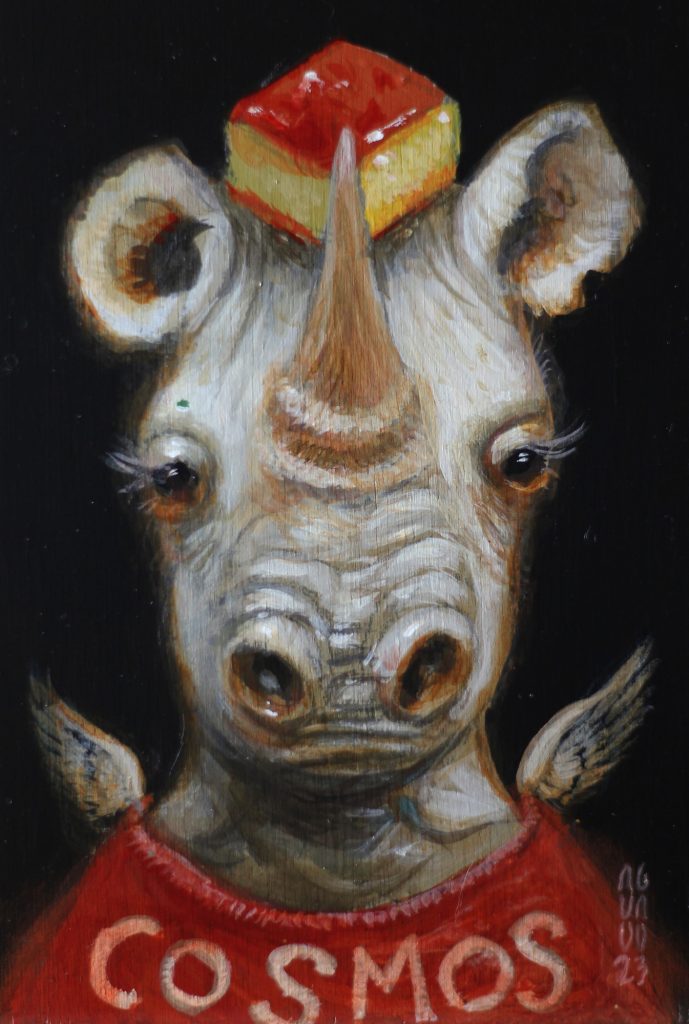
In an art world that often treats accessibility and profundity as enemies, Spanish artist Jesús Aguado has spent the last decade proving they might be secret collaborators. While most contemporary surrealists trace their lineage through prestigious academies, Aguado (b. 1976) spent twenty years in the trenches of commercial illustration—creating textbook art for Santillana, National Geographic, and children’s publishers across the globe. Rather than limiting his potential, this foundation became his greatest asset.
When Aguado transitioned to oil and acrylic painting around 2017-2018, he wasn’t just changing mediums—he was quietly engineering a new kind of surrealism that invites viewers in before blowing their minds. His “chimerical, often anthropomorphic figures” populate dream worlds that feel both fantastical and emotionally urgent, proving that commercial sensibilities and fine art depth can enhance rather than contaminate each other.
From Valladolid to Universal Language
Aguado’s artistic DNA was forged not in gallery spaces but in publishing deadlines. Born in Valladolid in 1976, he earned his Fine Arts credentials at the University of Salamanca before diving into two decades of editorial illustration. His client roster—spanning from Spanish textbook giant Santillana to publishers across Taiwan—provided intensive training in universal visual communication. When your art must work for Spanish schoolchildren and Taiwanese readers alike, you learn something profound about crossing cultural boundaries through imagery.
This wasn’t mere commercial work; it was a masterclass in making complex ideas accessible. Twenty years of editorial constraints built creative pressure that finally exploded into fine art—not as rebellion against his past, but as mastery seeking new expression.
Baroque Surrealism: When Old Masters Meet Comic Books
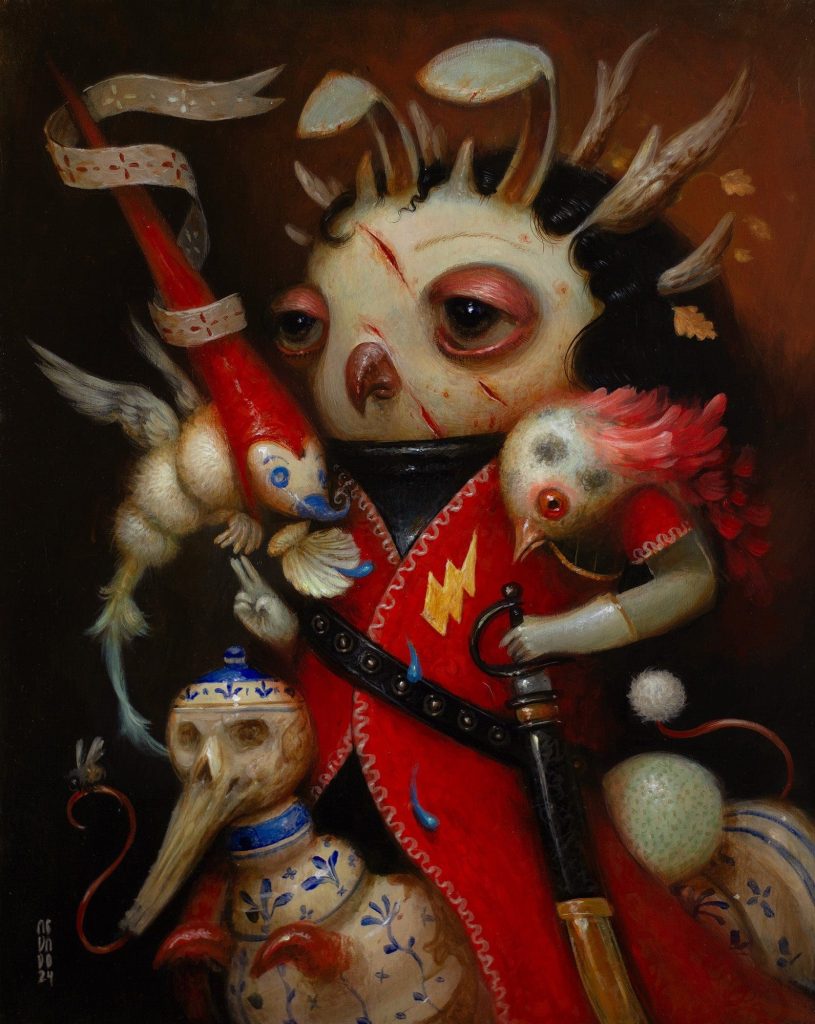
Aguado’s breakthrough came from an unlikely fusion: Renaissance technique meets comic book imagination. A self-proclaimed “comics fan” who happens to master classical methods, he creates what critics call “Renaissance beauty impregnated with the darkest baroque”—academic poetry that captures something genuinely revolutionary.
His compositions pulse with dramatic chiaroscuro borrowed from Caravaggio and the horror vacui (fear of empty space) of Rubens, but applied to fantastical creatures that could populate a cosmic graphic novel. The result is “Baroque Surrealism”—art that throbs with classical emotionality while bubbling with irreverent humor.
The Density Principle
Aguado’s canvases operate like visual novels, packed with narrative threads that reward sustained looking. His paintings are “a feast for the eyes full of bold colors and a myriad of animals, plants and creatures, blending one world with many others.” This isn’t chaos—it’s strategic overwhelm that mirrors the information density of our digital age while offering refuge from it.
His recurring cast—dragons representing ferocity, rabbits embodying cuteness, worms suggesting the grotesque—creates a bestiary of “dual animated beings that parade on the edge of the endearing and the disturbing.” By largely banishing humans from his compositions, Aguado creates universal characters that viewers can project onto without demographic barriers.
Technical Alchemy: Light as Philosophy
Aguado’s signature technique builds meaning through method. His acrylic glazing creates translucent layers that capture and bounce light between surfaces, transforming paint into luminosity that makes impossible creatures feel tangibly present. Each layer builds translucency, creating his signature shimmer that rewards close examination—a deliberate antidote to digital-age instant consumption.
Significantly, he paints on traditional wood panels and birch supports used by Renaissance masters. This isn’t nostalgia but strategic dialogue with art history. The classical weight of wood lends gravitas to whimsical subjects, while contemporary techniques inject new life into historical formats. It’s Hieronymus Bosch reimagined with modern psychology and comic book sensibilities.
The Father’s Transformation: Art Meets Life
The most significant development in Aguado’s career came in 2023 with the birth of his son. Fatherhood hasn’t sentimentalized his work—it’s deepened it. “Since he was born, I’ve been thinking a lot about life, about the crucial moments in a person’s development, both on a personal and general level, as well as a metaphysical one.”
This biographical shift sparked his latest series, “Life Milestones,” where octopus stumps garden with lobster claws and winged caterpillar mothers wield hammers during mitosis. These aren’t random surreal images—they’re visual metaphors for those transformative moments that “changed your course” or became “embedded in the deepest part of your being.”
“Experiencing life through your child again makes you think and reconsider everything you’ve been through in life,” Aguado reflects. His exploration of existential paradoxes now carries parental urgency, creating works that are simultaneously “metaphorical—and funny” while representing life’s most significant passages.
Psychological Architecture: Building Sanctuaries for Overstimulated Minds
Aguado’s mission cuts straight to our contemporary condition. He wants viewers to “feel far away from everything” because our world is “filled with too much information and opinions” that he finds “exhausting.” This isn’t artistic pretension—it’s cultural diagnosis with a visual prescription.
His “constant exploration of life’s paradoxes” creates what he calls spaces where “joy and darkness coexist” and where “light and love are appreciated after experiencing darkness.” The result is art that captures “vivacious ecstasy of tranquil joy” while refusing to offer easy emotional solutions.
His “absurd yet symbolic satires” function as pressure valves for information-overloaded audiences. By creating spaces where “free play of our imaginations” is essential rather than optional, he offers something increasingly rare: permission to stop processing and start feeling.
Beyond Movement: The Future of Accessible Profundity
While Aguado has conquered the Lowbrow/Pop Surrealism movement, his sophisticated fusion of classical techniques with existential themes suggests he’s outgrowing those boundaries. His third solo exhibition with Arch Enemy Arts since 2020 represents more than career momentum—it’s evidence of sustained institutional confidence in an artist bridging commercial appeal with intellectual depth.
Aguado has achieved something remarkable: he’s created a completely new visual language that feels both ancient and urgently modern. In a cultural moment when escapism often feels like surrender, he offers escape that expands rather than diminishes consciousness.
His legacy may well be proving that surrealism didn’t need to choose between emotional accessibility and intellectual depth, between pop appeal and art historical significance. In a field obsessed with either/or thinking, he’s built his reputation on “and/both” solutions—the kind of paradoxical thinking our complex world desperately needs.
The Bottom Line
Jesús Aguado has spent a decade proving that an artist’s commercial background can become their fine art superpower. By refusing to abandon his roots in universal visual communication, he’s created surrealism for the 21st century—art that offers psychological refuge while expanding consciousness, that makes the profound approachable without dumbing it down. In an era demanding navigation of contradiction with grace, Aguado has created the visual vocabulary we need.
LIFE MILESTONES by Jesus Aguado
Is currently on display at Arch Enemy Arts, Philadelphia.
On view: May 24 – June 15, 2025 Location: Arch Enemy Arts, Philadelphia Opening Reception: First Friday, June 6, 2025
The Painterly AI Aesthetics of Jacob Holster (@bandyquantguy) In a landscape dominated by hyper-realistic renders and glossy digital imagery, the work of Jacob Holster offers a refreshing counterpoint. Operating under…
In This Article: About Christian Quintin Christian Quintin doesn’t paint what he sees. He paints what you remember feeling—before you had words for it. His images arrive like déjà vu:…
I. The Iris of the Algorithmic Storm: A Proclamation The present epoch witnesses reality’s membrane stretched taut, shimmering with the chromatic aberrations of a thousand imminent worlds. It is a…